Proud members of:




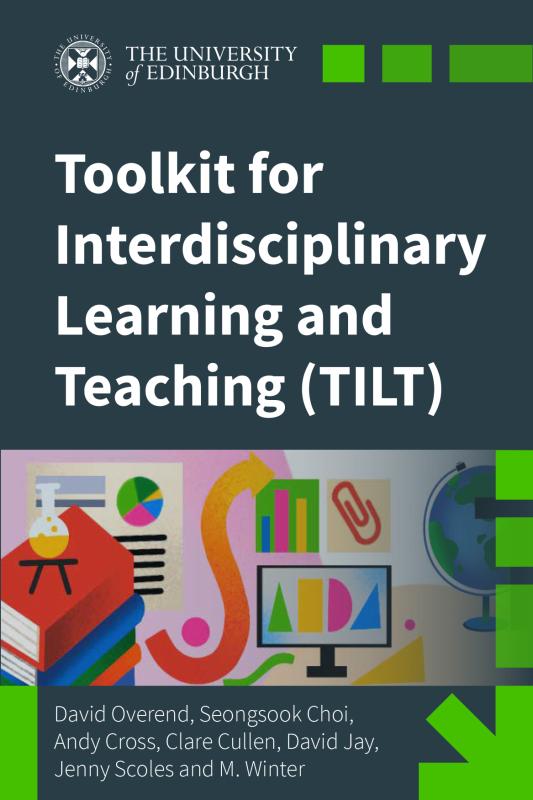
This e-book presents the Toolkit for Interdisciplinary Learning and Teaching (TILT) as a comprehensive and accessible resource designed to support educators, course designers, researchers, and learners engaged in interdisciplinary education. The toolkit brings together multiple strands of thought and practice: conceptual framings of interdisciplinarity, practical case studies of teaching and learning across boundaries, strategies for collaboration, methodological approaches to working between disciplines, assessment practices suited to interdisciplinary activity, and the ethical and reflexive dimensions of interdisciplinary practice. TILT invites users to rethink traditional disciplinary approaches to education by working across and beyond established structures, enabling reflection on how knowledge is constructed, shared, and mobilised in evolving educational contexts. The insights and resources in the toolkit can be embedded across a wide range of institutional settings, from secondary schools to higher-education programmes. Readers will find not only conceptual foundations but also rich pedagogical tools, including design patterns, teaching activities, student perspectives, video prompts, assessment matrices, and examples of interdisciplinary practice. These resources have been developed to be adaptable across diverse disciplines and educational contexts. The toolkit addresses key challenges of interdisciplinary work—such as negotiating vocabularies, coordinating between disciplinary norms, aligning learning outcomes, and assessing integrative student work—while offering practical strategies to navigate them effectively. Ultimately, this publication positions TILT as a bridge between scholarly research into interdisciplinarity and the everyday practice of teaching and learning in dynamic institutional environments. It provides a timely and practical resource for those committed to fostering integrative thinking, boundary-spanning collaboration, and innovative pedagogies that prepare learners to address complex challenges in a rapidly changing world.
Augsburg, T. (2014) Becoming Transdisciplinary: The Emergence of the Transdisciplinary Individual, World Futures 70:3-4, 233-247.
Baeten, M., Struyven, K., & Dochy, F. (2013). Student-centred teaching methods: Can they optimise students’ approaches to learning in professional higher education? Studies in Educational Evaluation, 39(1), 14–22.
Bammer, G. (2013). Disciplining interdisciplinarity: Integration and implementation sciences for researching complex real-world problems. ANU Press.
Barad, K. (2007). Meeting the universe halfway: Quantum physics and the entanglement of matter and meaning. Duke University Press.
Barad, K., & Gandorfer, D. (2021). Political desirings: Yearnings for mattering (,) differently. Theory & Event, 24(1), 14–66.
Barkley, E. F., Cross, K. P., & Major, C. H. (2014). Collaborative learning techniques. Jossey-Bass.
Barry, A., Born, G., & Weszkalnys, G. (2008). Logics of interdisciplinarity. Economy and Society, 37(1), 20–49.
Bawaka Country, Suchet-Pearson, S., Wright, S., Lloyd, K., Tofa, M., Sweeney, J., Burarrwanga, L., Ganambarr, R., Ganambarr-Stubbs, M., Ganambarr, B., & Maymuru, D. (2019). Goŋ Gurtha: Enacting response-abilities as situated co-becoming. Environment and Planning D: Society and Space, 37(4), 682-702.
Baylor University (n.d.). Ungrading. https://atl.web.baylor.edu/teaching-guides/assessing-student-learning-and-teaching/ungrading. Accessed 5 March 2026.
Biehl-Missal, B. (2010). Hero takes a fall: A lesson from theatre for leadership. Leadership, 6(3), 279-294.
Birenbaum, M. (2003). New insights into learning and teaching and their implications for assessment. In: M. Segers, F. Dochy & E. Cascallar (eds.). Optimizing new modes of assessment: In search of qualities and standards, (pp. 13–36). Kluwer Academic Publishers.
Blum, S. D. (ed.). (2020). Ungrading: Why rating students undermines learning (and what to do instead). West Virginia University Press.
Bogotch, I., Beachum, F., Blount, J., Brooks, J., & English, F. (2008). Radicalizing educational leadership: Dimensions of social justice (Vol. 2). Brill.
Boud, D., Cohen, R. & Walker, D. (1993). Using experience for learning. Open University Press.
Bovill, C. (2019). A co-creation of learning and teaching typology: What kind of co-creation are you planning or doing?. International Journal for Students as Partners, 3(2), 91-98.
Bozalek, V. & Zembylas, M. (2018). Practicing reflection or diffraction? Implications for research methodologies in education. In: R. Braidotti, V. Bozalek, T. Shefer & M. Zembylas (eds.), Socially just pedagogies: Posthumanist, feminist and materialist perspectives in higher education, (pp. 47–62). Bloomsbury.
Braun, V., & Clarke, V. (2006). Using thematic analysis in psychology. Qualitative Research in Psychology, 3(2), 77-101.
Burnell, I. (2019). Widening participation for non-traditional students: Can using alternative assessment methods level the playing field in higher education? Widening Participation and Lifelong Learning, 21(3), 162-173.
Burns, J. (1978). Leadership. Harper & Row.
Chandler, D. (2002). Semiotics: The basics. Routledge.
Chivers, T., & Chivers, D. (2022) How to read numbers: A guide to statistics in the news (and knowing when to trust them). Weidenfeld & Nicolson.
Christoffersen, A. (2021). The politics of intersectional practice: Competing concepts of intersectionality. Policy & Politics, 49(4), 573-593.
Clarke, V., & Braun, V. (2013). Teaching thematic analysis: Overcoming challenges and developing strategies for effective learning. The Psychologist, 26(2), 120–123.
Cole, E. R. (2016). ‘Foreword: Teaching intersectionality for our times’. In: K.A. Case (ed.). Intersectional pedagogy: Complicating identity and social justice, (pp. ix-xii). Routledge.
Creswell, J. W., & Creswell, J. D. (2022). Research Design: Qualitative, quantitative, and mixed methods approaches, 6th ed. Sage.
Cullinane, A. (2024). Embedding a reflective portfolio for student development in science courses: Challenges, suggestions, and solutions. Teaching Matters. https://www.teaching-matters-blog.ed.ac.uk/embedding-a-reflective-portfolio-for-student-development-in-science-courses-challenges-suggestions-and-solutions/. Accessed 6 March 2026.
Cullen, C., Jay, D., Overend, D. & Winter, M. (2024). Creating Edinburgh: Diffracting interdisciplinary learning and teaching in the contemporary city. Humanities and Social Sciences Communications, 11, 1151.
Daley, J., & Baruah, B. (2021). Leadership skills development among engineering students in Higher Education: An analysis of the Russell Group universities in the UK. European Journal of Engineering Education, 46(4), 528-556.
Davies, L.J. (2021). No grades, no classes, just pass/fail. LSE Higher Education Blog, https://blogs.lse.ac.uk/highereducation/2021/10/08/no-grades-no-classes-just-pass-fail/. Accessed 5 March 2026.
Dewey, J. (1933). How we think: A restatement of the relation of reflective thinking to the educative process. D.C Heath & Company.
Dietrich, W. (2014). A brief introduction to transrational peace research and elicitive conflict transformation. Journal of Conflictology, 5(2), 48-57.
Docherty, K. (2024). A 4-principle approach for strengthening relationships and working differently. Edinburgh Futures Institute. https://efi.ed.ac.uk/a-4-principle-approach-for-strengthening-relationships-and-working-differently/. Accessed 5 March 2026.
Dritsas, L. (2019). Assessing tutorial participation through reflective practice. Teaching Matters. https://www.teaching-matters-blog.ed.ac.uk/assessing-tutorial-participation-through-reflective-practice/. Accessed 5 March 2026.
Fielding, M. (1999). Radical collegiality: Affirming teaching as an inclusive professional practice, Australian Educational Researcher, 26(2), 1-34.
Finlay, L. (2021). Thematic analysis: The ‘good’, the ‘bad’ and the ‘ugly’. European Journal for Qualitative Research in Psychotherapy, 11, 103–116.
Fischer, N., & Mehnert, W. (2021). Building Possible Worlds: A speculation based framework to reflect on images of the future, Journal of Futures Studies, 25(3), 25-38.
Freire, P. (1970). Pedagogy of the Oppressed. Seabury Press.
Frodeman, R. (2017). The future of interdisciplinarity: An introduction to the 2nd edition. In R. Frodeman, J. T. Klein, & R. C. Dos Santos Pacheco (eds.), The Oxford handbook of interdisciplinarity, 2nd ed., (pp. 3-8). Oxford University Press.
Garfield, Z. H., Syme, K. L., & Hagen, E. H. (2020). Universal and variable leadership dimensions across human societies. Evolution and Human Behavior, 41(5), 397-414.
Gough, N. (2013). Towards Deconstructive Nonalignment: A complexivist view of curriculum, teaching and learning. South African Journal of Higher Education, 27(5), 1213-1233.
Greenpeace. (n.d.) Sustainability: A simple guide to a vital idea. https://www.greenpeace.org.uk/challenges/sustainability. Accessed 5 March 2026.
Gonzales, J. (2015) Meet the single point rubric, Cult of pedagogy blog. https://www.cultofpedagogy.com/single-point-rubric/. Accessed 5 March 2026.
Gunter, H. (2010). A sociological approach to educational leadership. British Journal of Sociology of Education, 31(4), 519-527.
Harvey, M., Coulson, D., Mackaway, J. & Winchester-Seeto, T. (2010). Aligning reflection in the cooperative education curriculum. Journal of Co-operative Education, 11(1), 137-152.
Hawkins, H. (2021). Geography, art, research: Artistic research in the GeoHumanities. Routledge.
Haraway, D. (2016). Staying with the trouble: Making kin in the Chthulucene. Duke University Press.
Haraway, D. (2018). Modest_Witness@Second_Millennium.FemaleMan©_Meets_OncoMouseTM, 2nd ed. (Original work published in 1997). Routledge.
Hill, C. M. (2017). More-than-reflective practice: Becoming a diffractive practitioner, Teacher Learning and Professional Development, 2(1), 1-17.
Johnson, A. R. (2007). An anthropological approach to the study of leadership: Lessons learned on improving leadership practice. Transformation, 24(3/4), 213-221.
Kashtan, M. (2020). The highest common denominator: Using convergent facilitation to reach breakthrough collaborative decisions. Fearless Heart Publications.
Katz-Buonincontro, J. (2011). Improvisational theatre as public pedagogy: A case study of ‘aesthetic’ pedagogy in leadership development. Policy Futures in Education, 9(6), 769-779.
Kleiman, P. (2007). Negotiating assessment: An approach to assessing practical work, including assessment criteria. PALATINE, Higher Education Academy. https://cielassociates.co.uk/wp-content/uploads/2014/08/KLEIMAN2007Negotiating-Assessment.pdf. Accessed 5 March 2026.
Klein J. T. (2017). Typologies of interdisciplinarity: The boundary work of definition. In: R. Frodeman (ed.), The Oxford handbook of interdisciplinarity, 2nd ed. (pp. 21-34), Oxford University Press.
Koh, E., & Doroudi, S. (2023). Learning, teaching, and assessment with generative artificial intelligence: towards a plateau of productivity. Learning: Research and Practice, 9(2), 109–116.
Leander, C. (2022). Why I ungrade, and a how-to primer, University of British Columbia Blogs. https://blogs.ubc.ca/celesteleander/2022/03/17/why-i-ungrade-and-a-how-to-primer/. Accessed 6 March 2026.
Lindvig, K., Lyall, C. & Meagher, L.R. (2019). Creating interdisciplinary education within monodisciplinary structures: the art of managing interstitiality, Studies in Higher Education, 44(2), 347-360.
Lury, C. (2018). ‘Introduction: Activating the present of interdisciplinary methods’, In: C. Lury, R. Fensham, A. Heller-Nicholas, S. Lammes, A. Last, M. Michael & E. Uprichard (eds.), Routledge handbook of interdisciplinary research methods, (pp.1-25), Routledge.
Lyall, C., Bruce, A., Tait, J., & Meagher, L. (2015). Interdisciplinary Research Journeys: Practical Strategies for Capturing Creativity. Bloomsbury Academic.
McCune, V., Tauritz, R., Boyd, S., Cross, A., & Higgins, P. (n.d.). About: The Wicked Problems Project. University of Edinburgh. http://www.wickedproblems.ed.ac.uk/sample-page/. Accessed 6 March 2026.
McGuigan, J. (2010). Cultural analysis. Sage.
Miettinen, L. (2024). We can now measure biodiversity footprints – here’s how. Sitra. https://www.sitra.fi/en/articles/we-can-now-measure-biodiversity-footprints-heres-how/. Accessed 6 March 2026.
Modeen, M. & Biggs, I. (2021). Creative engagements with ecologies of place: Geopoetics, deep mapping and slow residencies. Routledge.
Monbiot, G. (2012). How ‘sustainability’ became ‘sustained growth’. https://www.monbiot.com/2012/06/22/how-sustainability-became-sustained-growth/. Accessed 6 March 2026.
Moran, J. (2010). Interdisciplinarity, Routledge.
Murris, K. (2022). Karen Barad as educator: Agential realism and education. Springer.
Nelson, R. (2022). Practice as research in the arts (and beyond): Principles, processes, contexts, achievements. Springer.
Okamura, K. (2019). Interdisciplinarity revisited: evidence for research impact and dynamism. Palgrave Communications, 5(1), 141.
Okudan, G. E., & Rzasa, S. E. (2006). A project-based approach to entrepreneurial leadership education. Technovation, 26(2), 195-210.
Ortiz-Ospina, E. (2017). ‘Life Expectancy’ – What does this actually mean? OurWorldInData.org. https://ourworldindata.org/life-expectancy-how-is-it-calculated-and-how-should-it-be-interpreted. Accessed 6 March 2026.
Overend, D. & Lorimer, J. (2018). Wild performatives: Experiments in rewilding at Knepp Wildland Project. GeoHumanities, 4(2), 527-542.
Overend, D., Ewing, S. & Swanton, D. (2024). ‘Loose ends and missing links’: Learning journeys in the postdigital city. In: J. Lamb & L. Carvalho (eds.) Postdigital learning spaces: Towards convivial, equitable, and sustainable spaces for learning, (pp. 99-118). Springer.
Overend, D., Choi, S., Cross, A. & Winter, M. (2026). Future change agents: Emotional interactions in the challenge-based classroom: In S. Scott & I. Kemp (eds.), Interdisciplinary Learning and Teaching: Practice and pedagogies, (pp. 138-160). Ethics Press.
Pansardi, P. & Bindi, M. (2021) The new concepts of power? Power-over, power-to and power-with, Journal of Political Power, 14(1), 51-71.
Reflection Toolkit, the (n.d.), McCabe, G. & Thejll-Madsen, T. (eds.). University of Edinburgh. https://reflection.ed.ac.uk. Accessed 6 March 2026.
Ritchie, J., Lewis, J., McNaughton Nicholls, C., & Ormston, R. (eds.) (2014) Qualitative research practice: A guide for social science students and researchers, 2nd ed. Sage.
Sanders, D., & Davies, P. (2023). Bringing Barad into outdoor learning: A reflective case study concerning quadrats and agential cuts in ecology education. In: P. Patrick (ed.), How People Learn in Informal Science Environments, (pp. 313-333), Springer.
Schein, E. H. (2013). Humble inquiry: The gentle art of asking instead of telling. Berrett-Koehler.
Schön, D. (1983). The reflective practitioner. How professionals think in action. Temple Smith.
Senge, P., Hamilton, H., & Kania, J. (2015). The dawn of system leadership. Stanford Social Innovation Review, 13(1), 27-33.
Shepard, L. (2000). The Role of Assessment in a Learning Culture. Educational Researcher, 29(7), 4–14.
Silverman, D. (ed.) (2021). Doing qualitative research, 6th ed. Sage.
Smith, L. T. (2012). Decolonizing Methodologies: Research and Indigenous peoples, 2nd ed. Zed Books.
Spector, K. (2015). Meeting pedagogical encounters halfway. Journal of Adolescent and Adult Literacy, 58(6), 447–450.
Stommel, J. (2020) Ungrading: An FAQ. https://www.jessestommel.com/ungrading-an-faq/. Accessed 5 March 2026.
Toivonen, T., Heikinheimo, V., Fink, C., Hausmann, A., Hiippala, T., Järv, O., Tenkanen, H. & Di Minin, E., (2019). Social media data for conservation science: A methodological overview. Biological Conservation, 233, 298-315.
Turner, R., Cotton, D., Morrison, D. & Kneale, P. (2024). Embedding interdisciplinary learning into the first-year undergraduate curriculum: drivers and barriers in a cross-institutional enhancement project. Teaching in Higher Education, 29(4), 1092–1108.
United Nations (n.d.-a), Goal 10: Reduce inequality within and among countries, Sustainable Development Goals. https://www.un.org/sustainabledevelopment/inequality/. Accessed 6 March 2026.
United Nations (n.d.-b), The 17 Goals, Sustainable Development Goals. https://sdgs.un.org/goals. Accessed 6 March 2026.
UNESCO Chair for Peace Studies, ‘Elicitive Conflict Transformation,’ https://www.youtube.com/watch?v=uQuOIbY3c4g. Accessed 6 March 2026.
Villarroel, V., Bloxham, S., Bruna, D., Bruna, C., & Herrera-Seda, C. (2017). Authentic assessment: creating a blueprint for course design. Assessment and Evaluation in Higher Education, 43(5), 840–854.
Viviani, L. (2017). A political sociology of populism and leadership. SocietàMutamentoPolitica, 8(15), 279-304.
Wallace, R. L., & Clark, S. G. (2017) Barriers to Interdisciplinarity in environmental studies: A case of alarming trends in faculty and programmatic wellbeing. Issues in Integrative Studies, 35(1), 221-247.
White, F., Lloyd, H., Kennedy, G., & Stewart, C. (2005). An investigation of undergraduate students’ feelings and attitudes towards group work and group assessment. Research and Development in Higher Education, 28(1), 618-623.
Wilson, D., Lai, Z., & Eilenberger, F. (2024). Mirrors of growth: The power of reflections in learning. Teaching Matters. https://www.teaching-matters-blog.ed.ac.uk/mirrors-of-growth-the-power-of-reflections-in-learning/. Accessed 6 March 2026.
Winter, M. & Overend, D. (2024). Troubling leadership in the interdisciplinary challenge-based classroom. Issues in Interdisciplinary Studies, 41(2), 77-100.
WWF (World Wide Fund for Nature) & ZSL (Zoological Society of London). (2024). Living Planet Index. https://www.livingplanetindex.org/lpi. Accessed 6 March 2026.
WWF. (2024). Living Planet report 2024: A system in peril. WWF.
Proud members of:

About | Contact Us | Take Down Policy | Privacy | Cookies | Accessibility Statement | Accessibility Statement (backend) | Freedom of Information | Terms and Conditions
Edinburgh Diamond Service Homepage | Resources | Submit a Book Proposal
The University of Edinburgh is a charitable body, registered in Scotland, with registration number SC005336, VAT Registration Number GB 592 9507 00, and is acknowledged by the UK authorities as a “Recognised body” which has been granted degree awarding powers.