Proud members of:



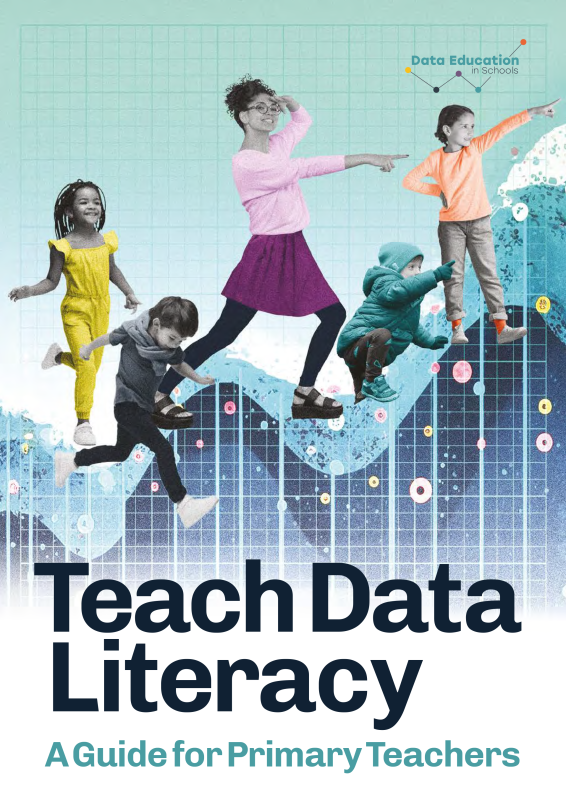
Do you wince at the thought of data literacy, or sigh with relief that it is it now recognised as an essential part of all children and young people’s learning? Either way, this handbook is here to help.
Data literacy is the set of skills and concepts which people need to understand, interpret and make decisions based on the data they encounter in the world around them. There is no official area of the
curriculum, or topic, labelled “data literacy” in the Curriculum for Excellence in Scotland. However it is relevant across the curriculum in outcomes for maths, literacy, technologies, and social studies.
This handbook sets out how, building on children and young people’s curiosity about their world, teachers can enhance opportunities for all to build the skills and habits of mind relevant to data problem-solving.
OECD. (2019). Well-being 2030 Action OECD Future of Education and Skills 2030: A Series of Concept Notes. www.oecd.org.
Wolff, A., Gooch, D., Cavero Montaner, J.J, Rashid, U., Kortuem, G., (2016). Creating an Understanding of Data Literacy for a Data-driven Society. The Journal of Community Informatics, 12(3), 9-26. P23
There are some great examples of job opportunities in data on our free poster at: https://dataschools.education/put-your-data-skills-to-work/
Wild, C. J. (2017). Statistical Literacy as the Earth Moves. Statistics Education Research Journal, 16(1), 31–37. P32
This quote is from a letter from Einstein to Carl Seelig, March 11, 1952, AEA 39-013: https://www.asl-associates.com/einsteinquotes.htm
You can find a complete list of data literacy related outcomes and expectations across the curriculum here: https://dataschools.education/resource/experiences-and-outcomes/
Spiegelhalter, D. J. The Art of Statistics : Learning from Data / David Spiegelhalter. UK: Pelican, an imprint of Penguin Books, 2019. Print. P18
Wild, C. J. (2017). Statistical Literacy as the Earth Moves. Statistics Education Research Journal, 16(1), 31–37. P32
Note that this is a slightly different meaning to “variable” in algebra or computer programming.
Bargagliotti, A., Franklin, C., Arnold, P., Gould, R., Johnson, S., Perez, L., & Spangler, D. A. (2020). Pre-K-12 Guidelines for Assessment and Instruction in Statistics Education II (GAISE II) A Framework for Statistics and Data Science Education. https://www.amstat.org/education/guidelines-for-assessment-and-instruction-in-statistics-education-(gaise)-reports
Adapted from Wolff, A., Gooch, D., Montaner, C., Rashid, J. J., Kortuem, U., Wolff, A., Kortuem, G. (2016). Creating an Understanding of Data Literacy for a Data-driven Society. The Journal of Community Informatics, 12(3), 9–26. Retrieved from www.ci-journal.net/index.php/ciej/article/view/1286.
You can find some examples of real-world datasets for classroom use here: https://dataschools.education/resource/seasonal-datasets/ and https://concord-consortium.github.io/codap-data/
https://5rightsfoundation.com/KnowYourRightsPoster.pdf
Harford, Tim. How to Make the World Add up / Tim Harford. The Bridge Street Press. 2020. Print. P294
Spiegelhalter, D. J. The Art of Statistics : Learning from Data / David Spiegelhalter. UK: Pelican, an imprint of Penguin Books, 2019. Print. P15
https://www.co2indicator.nl/documentatie/Ventilation-Rates-in-Schools-and-Pupils-Performance.pdf
http://www.iaquk.org.uk/ResourcesCO2.html
https://www.gapminder.org/tools/
Harford, Tim. How to Make the World Add up / Tim Harford. The Bridge Street Press. 2020. Print. P10
Silver, Nate. The Signal and the Noise : the Art and Science of Prediction / Nate Silver. London: Penguin Books, 2013. Print. P9
Harford, Tim. How to Make the World Add up / Tim Harford. The Bridge Street Press. 2020. Print. P280
Available from: https://dataschools.education/data-education-resources/
Arnold, P., & Franklin, C. (2021). What Makes a Good Statistical Question? Journal of Statistics and Data Science Education, 29(1), 122–130. https://doi.org/10.1080/26939169.2021.1877582

This work is licensed under a Creative Commons Attribution-ShareAlike 4.0 International License.
Proud members of:

About | Contact Us | Take Down Policy | Privacy | Cookies | Accessibility Statement | Accessibility Statement (backend) | Freedom of Information | Terms and Conditions
Edinburgh Diamond Service Homepage | Resources | Submit a Book Proposal
The University of Edinburgh is a charitable body, registered in Scotland, with registration number SC005336, VAT Registration Number GB 592 9507 00, and is acknowledged by the UK authorities as a “Recognised body” which has been granted degree awarding powers.